

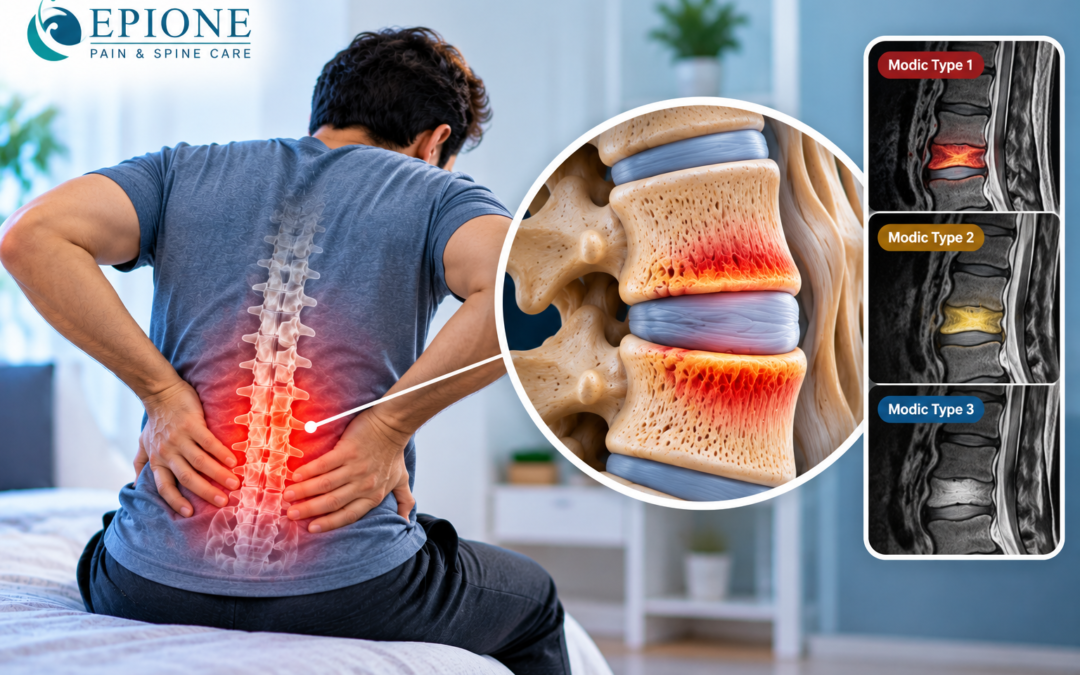
Quick answer: Modic changes are MRI signal changes in the vertebral bone next to a spinal disc. They can be associated with endplate degeneration and, in selected patients, vertebrogenic pain, but they are not automatically the cause of symptoms and should not be treated in isolation from the clinical examination.
Key takeaways
- Modic changes back pain should be understood in clinical context, not from one symptom or scan alone.
- The most useful treatment plan starts with a plausible pain mechanism and measurable functional goals.
- Newer research can improve patient selection, but emerging evidence should not be marketed as a guaranteed cure.
People rarely search for “Modic changes back pain” because they want a textbook definition. Usually there is a real decision behind the search: a scan report that is confusing, pain that has not improved, or a new treatment name that sounds promising but is hard to evaluate. This guide is written to make that decision easier. It explains what clinicians mean by the term, where the evidence is strong or still emerging, and which questions are worth taking to a specialist appointment.
Why MRI reports create anxiety
An MRI report can read like a list of problems even when several findings are common age-related changes. Terms such as “Modic type 1,” “Modic type 2,” “disc desiccation” and “endplate change” often sound alarming because they are unfamiliar. The first useful step is to separate what the scan describes from what the patient actually feels.
Modic changes refer to signal changes in the vertebral bone marrow adjacent to a disc. They are named after the radiologist who described the pattern. They do not mean that the spine is “crumbling,” and they do not by themselves determine treatment. The more useful question is whether the location and type of change fit a credible pain mechanism in that individual.
Modic type 1 and type 2 in plain language
Type 1 changes are generally associated with edema-like and inflammatory signal at the endplate region. Type 2 changes reflect more fatty marrow replacement. Type 3, which is less often discussed, relates to sclerosis. These are imaging patterns, not symptom scores; the intensity of pain cannot be read directly from the MRI.
A 2026 review of vertebrogenic low back pain highlighted Modic type 1 and type 2 changes as part of imaging-based patient selection for basivertebral-nerve-focused approaches. The important phrase is “patient selection.” The scan must fit the history, examination and overall clinical picture before it can meaningfully guide a decision.
Do Modic changes explain every episode of back pain?
No. Someone can have Modic changes and another pain source, such as a facet joint, sacroiliac joint, disc, muscle or irritated nerve root. Conversely, a patient can have substantial pain with relatively modest structural findings. This is one reason a skilled low back pain treatment assessment does not stop at the radiology report.
The pattern of symptoms matters. Central axial pain that is consistently provoked by certain loading patterns may fit an endplate-related hypothesis better than classic leg-dominant radicular pain. If symptoms are predominantly shooting pain down the leg with numbness or weakness, a sciatica treatment evaluation may be more relevant.
What happens after Modic changes are found
The next step is usually not an immediate procedure. A clinician should review the duration of symptoms, function, prior rehabilitation, medication exposure, red flags, neurological findings and other MRI abnormalities. Treatment commonly starts with education, activity and rehabilitation adjusted to the patient’s tolerance and diagnosis.
When chronic pain remains severe despite appropriate conservative care, a pain specialist may consider whether a more specific intervention is justified. That decision should be based on a coherent diagnosis, not on the desire to “treat the MRI.” At a multidisciplinary pain management center, the goal is to identify the most likely pain generator and avoid unnecessary escalation.
What patients should ask when reading an MRI report
Ask three questions: Which finding best matches my symptoms? Which findings are common incidental changes? What would we do differently because of this MRI? Those questions convert a technical report into a clinical plan. They also make it easier to understand why two people with similar scans can require different treatment.
It can help to bring the actual MRI images, not only the written report, to a specialist appointment. A radiology report is valuable, but seeing the level and distribution of changes alongside the examination can improve clinical reasoning. Keep a short symptom timeline as well: onset, aggravating positions, leg symptoms, sleep impact and what treatments have already been tried.
Red flags still come first
Modic changes are generally discussed in the context of degenerative and chronic back pain. They do not replace screening for infection, fracture, cancer, cauda equina syndrome or rapidly progressive neurological disease. Severe back pain with fever, recent serious infection, major trauma, unexplained weight loss, new bladder or bowel problems, saddle numbness or progressive weakness needs prompt medical evaluation.
For non-emergency chronic back pain, the most useful approach is calm interpretation. An MRI can help clarify anatomy, but the treatment plan should remain centered on the person: symptoms, function, goals, risks and response to care.
What current evidence can—and cannot—tell us
A useful way to read newer pain research is to separate three questions: does the mechanism make biological sense, has it been demonstrated in the type of patient being discussed, and does treating that mechanism improve outcomes that matter to patients? For Modic changes back pain, those questions are more useful than asking whether the topic is simply “new” or “advanced.” Related search terms such as Modic type 1, Modic type 2, Modic changes MRI, vertebral endplate changes describe overlapping interests, but they should not be treated as interchangeable diagnoses. A study may show promising average improvement while still leaving uncertainty about which individual will respond, how long benefit lasts, and whether the result compares favorably with simpler care. This is particularly important in pain medicine because many studies enroll highly selected patients, use different definitions of success, and combine pain scores with functional outcomes in different ways. For patients, the safest interpretation is that evidence can guide a conversation; it cannot guarantee a personal result. For patients, the same principle improves decision-making: understand what is known, what remains uncertain, and whether the evidence is observational, randomized, or mainly mechanistic.
How a specialist turns the information into a treatment plan
When a patient is trying to understand Modic changes back pain, the next step should not be chosen from the search result alone. A specialist first asks what problem needs to be solved: Is the priority walking, sleeping, returning to work, reducing medication, or understanding a confusing scan? The clinician then builds a differential diagnosis, checks for warning signs, reviews previous care and decides whether more testing would actually change management. Where appropriate, that assessment can connect to low back pain treatment or sciatica treatment depending on which diagnosis best matches the symptoms. The purpose is to move from a broad symptom or question to the most relevant condition or treatment pathway, without assuming that every patient needs the same test or procedure.
A practical symptom diary before your consultation
Before a consultation, track symptoms for one to two weeks if the condition is stable and non-urgent. Note where the pain begins, where it spreads, what time of day it is worst, which movements or positions change it, whether there is numbness or weakness, how sleep is affected, and what you can no longer do comfortably. Record medicines and supplements, previous injections or procedures, and the actual benefit rather than only whether they were “tried.” If you have imaging, bring both the report and the images when possible. This kind of preparation creates a more human and more accurate consultation because the discussion starts with your lived pattern of symptoms instead of a generic label. It also gives the clinician a baseline for measuring whether treatment is genuinely helping. If symptoms are rapidly worsening, accompanied by new neurological deficits, fever, major trauma, loss of bladder or bowel control, or another emergency feature, do not wait to complete a diary—seek prompt medical assessment.
Expert pain assessment in Hyderabad
When pain is persistent, complex or not matching the scan, a specialist assessment can prevent treatment from being driven by a label alone. Epione identifies Dr. Minal Chandra, MBBS, DA, DNB, FIPM, as Co-Founder and Consultant Pain Specialist with 15+ years of experience in interventional pain medicine. For people in Hyderabad dealing with Modic changes back pain, an appointment with Epione’s pain team can help connect symptoms, examination findings, imaging and previous treatment before a more invasive option is considered. Patients can request a consultation and ask about Dr. Minal Chandra’s availability.
Learn more about Epione’s pain specialists and multidisciplinary care: Dr. Minal Chandra at Epione | Book an appointment
References
- 2026 review of Modic changes and vertebrogenic back pain
- 2026 review of vertebrogenic low back pain and BVN ablation
If pain is limiting sleep, work, walking or daily activity, consider a specialist review rather than choosing a procedure from a scan or search result alone. Request an Epione consultation and ask about Dr. Minal Chandra’s availability.
Frequently Asked Questions
1. What is Modic changes back pain?
Modic Changes Back Pain refers to the clinical concept described in this article. It should be diagnosed in context, not from one symptom or scan finding alone. For Modic changes back pain, the answer depends on the symptom pattern, examination findings, medical history and the goal of treatment. A qualified clinician can explain which findings are clinically important and whether testing, rehabilitation, medication or a targeted procedure is appropriate. Seek prompt medical care if symptoms are rapidly worsening or include a new neurological deficit or other warning sign.
2. What symptoms are associated with Modic changes back pain?
Symptoms vary by person and can overlap with other pain conditions. The pattern, location, triggers, neurological findings and effect on function are more useful than the diagnostic label itself. For Modic changes back pain, the answer depends on the symptom pattern, examination findings, medical history and the goal of treatment. A qualified clinician can explain which findings are clinically important and whether testing, rehabilitation, medication or a targeted procedure is appropriate. Seek prompt medical care if symptoms are rapidly worsening or include a new neurological deficit or other warning sign.
3. What is Modic changes back pain commonly confused with?
It can be confused with a definitive diagnosis of pain. A careful history and examination help separate overlapping conditions. For Modic changes back pain, the answer depends on the symptom pattern, examination findings, medical history and the goal of treatment. A qualified clinician can explain which findings are clinically important and whether testing, rehabilitation, medication or a targeted procedure is appropriate. Seek prompt medical care if symptoms are rapidly worsening or include a new neurological deficit or other warning sign.
4. How is Modic changes back pain diagnosed?
Diagnosis usually relies on MRI interpreted together with history and examination. No single online symptom checklist can confirm the diagnosis. For Modic changes back pain, the answer depends on the symptom pattern, examination findings, medical history and the goal of treatment. A qualified clinician can explain which findings are clinically important and whether testing, rehabilitation, medication or a targeted procedure is appropriate. Seek prompt medical care if symptoms are rapidly worsening or include a new neurological deficit or other warning sign.
5. Do I always need an MRI?
No. Imaging is used when it is likely to clarify the diagnosis, change management or investigate warning signs. The need for MRI depends on the clinical picture. For Modic changes back pain, the answer depends on the symptom pattern, examination findings, medical history and the goal of treatment. A qualified clinician can explain which findings are clinically important and whether testing, rehabilitation, medication or a targeted procedure is appropriate. Seek prompt medical care if symptoms are rapidly worsening or include a new neurological deficit or other warning sign.
6. Can a normal scan still occur with real pain?
Yes. Imaging shows anatomy, not pain intensity. Some painful mechanisms are not captured well on routine scans, while some abnormal findings occur in people without symptoms. For Modic changes back pain, the answer depends on the symptom pattern, examination findings, medical history and the goal of treatment. A qualified clinician can explain which findings are clinically important and whether testing, rehabilitation, medication or a targeted procedure is appropriate. Seek prompt medical care if symptoms are rapidly worsening or include a new neurological deficit or other warning sign.
7. Can two people with similar scans feel different levels of pain?
Yes. Pain reflects anatomy, inflammation, nerve function, movement, sleep, previous injury and nervous-system processing. Similar images do not guarantee similar symptoms. For Modic changes back pain, the answer depends on the symptom pattern, examination findings, medical history and the goal of treatment. A qualified clinician can explain which findings are clinically important and whether testing, rehabilitation, medication or a targeted procedure is appropriate. Seek prompt medical care if symptoms are rapidly worsening or include a new neurological deficit or other warning sign.
8. Is this condition dangerous?
Most presentations discussed here are not emergencies, but fever, major trauma, unexplained weight loss, bladder or bowel changes, saddle numbness or progressive weakness require prompt medical assessment. For Modic changes back pain, the answer depends on the symptom pattern, examination findings, medical history and the goal of treatment. A qualified clinician can explain which findings are clinically important and whether testing, rehabilitation, medication or a targeted procedure is appropriate. Seek prompt medical care if symptoms are rapidly worsening or include a new neurological deficit or other warning sign.
9. Can it improve without surgery?
Often, management starts with conservative care first, with selected interventions only when the diagnosis is well supported. Whether surgery is needed depends on the actual diagnosis and severity. For Modic changes back pain, the answer depends on the symptom pattern, examination findings, medical history and the goal of treatment. A qualified clinician can explain which findings are clinically important and whether testing, rehabilitation, medication or a targeted procedure is appropriate. Seek prompt medical care if symptoms are rapidly worsening or include a new neurological deficit or other warning sign.
10. What role does physiotherapy play?
Rehabilitation can improve strength, movement confidence, endurance and function when it is matched to the diagnosis. Generic exercises are less useful than a program based on the patient’s findings. For Modic changes back pain, the answer depends on the symptom pattern, examination findings, medical history and the goal of treatment. A qualified clinician can explain which findings are clinically important and whether testing, rehabilitation, medication or a targeted procedure is appropriate. Seek prompt medical care if symptoms are rapidly worsening or include a new neurological deficit or other warning sign.
11. Are pain medicines always necessary?
Not always. Medication decisions depend on pain mechanism, medical history, risks and functional goals. Long-term self-medication is not recommended. For Modic changes back pain, the answer depends on the symptom pattern, examination findings, medical history and the goal of treatment. A qualified clinician can explain which findings are clinically important and whether testing, rehabilitation, medication or a targeted procedure is appropriate. Seek prompt medical care if symptoms are rapidly worsening or include a new neurological deficit or other warning sign.
12. Can injections help?
Injections may help selected patients when there is a clear target and a specific diagnostic or therapeutic goal. They are not a substitute for diagnosis. For Modic changes back pain, the answer depends on the symptom pattern, examination findings, medical history and the goal of treatment. A qualified clinician can explain which findings are clinically important and whether testing, rehabilitation, medication or a targeted procedure is appropriate. Seek prompt medical care if symptoms are rapidly worsening or include a new neurological deficit or other warning sign.
13. Is radiofrequency treatment suitable for everyone?
No. Radiofrequency procedures are target-specific and should only be considered when the relevant nerve or joint has been identified and the expected benefit justifies the risk. For Modic changes back pain, the answer depends on the symptom pattern, examination findings, medical history and the goal of treatment. A qualified clinician can explain which findings are clinically important and whether testing, rehabilitation, medication or a targeted procedure is appropriate. Seek prompt medical care if symptoms are rapidly worsening or include a new neurological deficit or other warning sign.
14. How long does recovery take?
Recovery depends on the diagnosis and treatment chosen. Some conservative plans improve gradually over weeks, while procedures have their own short-term recovery instructions. For Modic changes back pain, the answer depends on the symptom pattern, examination findings, medical history and the goal of treatment. A qualified clinician can explain which findings are clinically important and whether testing, rehabilitation, medication or a targeted procedure is appropriate. Seek prompt medical care if symptoms are rapidly worsening or include a new neurological deficit or other warning sign.
15. Can the pain come back?
Yes. Recurrence is possible because pain generators can change and nerves or tissues can recover or be re-irritated. Long-term function and prevention strategies still matter. For Modic changes back pain, the answer depends on the symptom pattern, examination findings, medical history and the goal of treatment. A qualified clinician can explain which findings are clinically important and whether testing, rehabilitation, medication or a targeted procedure is appropriate. Seek prompt medical care if symptoms are rapidly worsening or include a new neurological deficit or other warning sign.
16. Does age affect treatment?
Age is only one factor. Overall health, diagnosis, neurological status, bone quality, medications and goals are usually more important than age alone. For Modic changes back pain, the answer depends on the symptom pattern, examination findings, medical history and the goal of treatment. A qualified clinician can explain which findings are clinically important and whether testing, rehabilitation, medication or a targeted procedure is appropriate. Seek prompt medical care if symptoms are rapidly worsening or include a new neurological deficit or other warning sign.
17. Can exercise make the condition worse?
The wrong load can aggravate symptoms, but appropriate graded activity is often part of recovery. Exercise should be adjusted if it causes progressive neurological symptoms or severe persistent worsening. For Modic changes back pain, the answer depends on the symptom pattern, examination findings, medical history and the goal of treatment. A qualified clinician can explain which findings are clinically important and whether testing, rehabilitation, medication or a targeted procedure is appropriate. Seek prompt medical care if symptoms are rapidly worsening or include a new neurological deficit or other warning sign.
18. When should I see a pain specialist?
Consider specialist review when pain persists despite appropriate initial care, the diagnosis is uncertain, symptoms significantly limit sleep or function, or an interventional option is being considered. For Modic changes back pain, the answer depends on the symptom pattern, examination findings, medical history and the goal of treatment. A qualified clinician can explain which findings are clinically important and whether testing, rehabilitation, medication or a targeted procedure is appropriate. Seek prompt medical care if symptoms are rapidly worsening or include a new neurological deficit or other warning sign.
19. What should I bring to an appointment?
Bring prior scan reports and images if available, a medication list, previous treatment records and a short timeline of symptoms, triggers and functional limitations. For Modic changes back pain, the answer depends on the symptom pattern, examination findings, medical history and the goal of treatment. A qualified clinician can explain which findings are clinically important and whether testing, rehabilitation, medication or a targeted procedure is appropriate. Seek prompt medical care if symptoms are rapidly worsening or include a new neurological deficit or other warning sign.
20. What is the most important treatment principle?
Treat the person and the dominant pain mechanism, not the scan or label. A clear diagnosis and measurable functional goals are more useful than chasing one procedure. For Modic changes back pain, the answer depends on the symptom pattern, examination findings, medical history and the goal of treatment. A qualified clinician can explain which findings are clinically important and whether testing, rehabilitation, medication or a targeted procedure is appropriate. Seek prompt medical care if symptoms are rapidly worsening or include a new neurological deficit or other warning sign.