

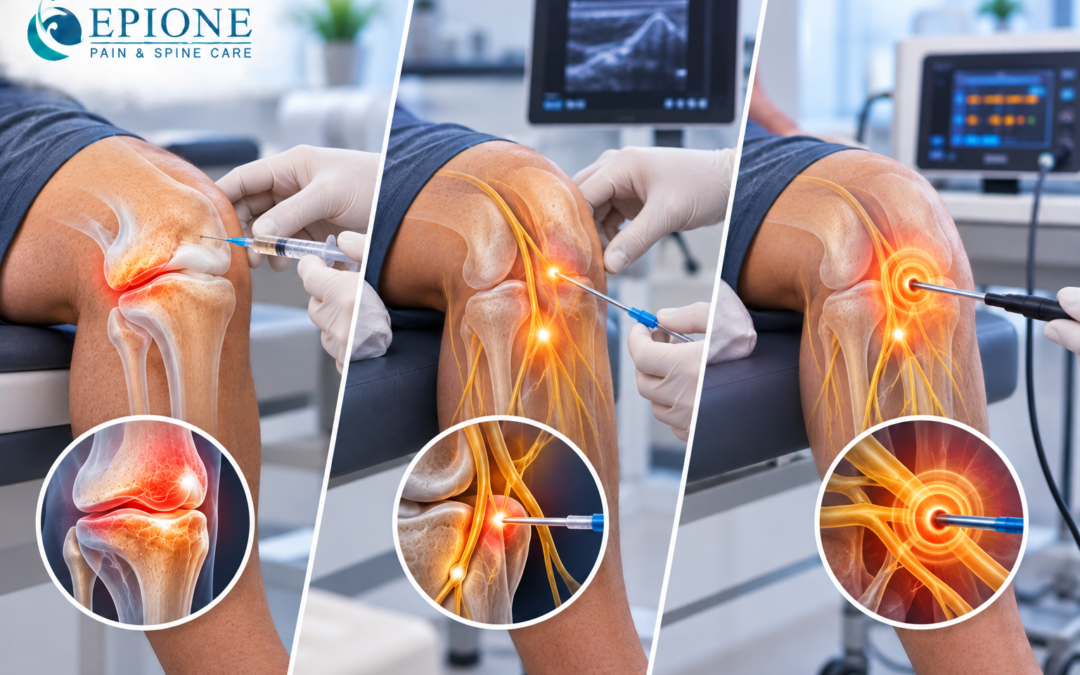
Quick answer: A knee joint injection places medication inside the joint, a genicular nerve block targets sensory nerves around the knee, and radiofrequency ablation uses energy to reduce pain signaling from selected nerves. They are not interchangeable, and the right option depends on diagnosis, prior response and treatment goals.
Key takeaways
- Knee injection vs nerve block vs radiofrequency ablation should be understood in clinical context, not from one symptom or scan alone.
- The most useful treatment plan starts with a plausible pain mechanism and measurable functional goals.
- Newer research can improve patient selection, but emerging evidence should not be marketed as a guaranteed cure.
People rarely search for “knee injection vs nerve block vs radiofrequency ablation” because they want a textbook definition. Usually there is a real decision behind the search: a scan report that is confusing, pain that has not improved, or a new treatment name that sounds promising but is hard to evaluate. This guide is written to make that decision easier. It explains what clinicians mean by the term, where the evidence is strong or still emerging, and which questions are worth taking to a specialist appointment.
Three procedures with three different targets
Patients often hear the words “injection,” “block” and “RFA” as if they describe the same treatment. They do not. An intra-articular knee injection targets the joint space. A genicular nerve block targets sensory nerves around the knee. Radiofrequency ablation uses radiofrequency energy to reduce pain transmission from selected nerves after the target has been identified.
The differences matter because a treatment should match the suspected pain mechanism. A joint with active inflammation, a severely degenerated joint with persistent nociceptive pain and a patient with neuropathic pain after surgery are different clinical situations.
Where joint injections fit
Joint injections may use corticosteroid, local anesthetic or other agents depending on diagnosis, evidence and local practice. Their purpose is usually to reduce inflammation or pain within the joint. They can provide temporary relief, but they do not reverse advanced osteoarthritis.
The decision should be part of a broader knee pain treatment plan that includes strength, activity, weight considerations when relevant and evaluation of mechanical symptoms. Repeating injections indefinitely without reassessing function and diagnosis is rarely a complete strategy.
Where genicular nerve blocks fit
Genicular nerve blocks focus on pain transmission rather than the joint surface itself. They may be used therapeutically or diagnostically. When used before RFA, the response can help determine whether the targeted sensory nerves are meaningful contributors to the pain.
A 2026 randomized trial examined genicular blocks with local anesthetic alone, local anesthetic plus corticosteroid and placebo, reflecting ongoing questions about the best injectate. Protocols vary, so patients should ask exactly what the block is intended to establish.
Where radiofrequency ablation fits
Knee RFA is generally considered when chronic knee pain persists and the sensory nerve target has been adequately evaluated. The procedure aims for longer-lasting modulation than a short-acting diagnostic block, although duration varies and nerves can recover over time.
RFA does not repair cartilage, realign the joint or replace rehabilitation. It is a pain-control strategy that may help selected people remain active. If symptoms change or new swelling, instability or locking develops, the knee should be reassessed rather than assuming the previous pain mechanism is still dominant.
How doctors choose among the options
The decision may consider osteoarthritis severity, previous injection response, surgical suitability, age, medical conditions, anticoagulation, diabetes, functional goals and whether the pain is primarily joint-based or neuropathic. Imaging can help, but the clinical examination still matters.
At a multidisciplinary pain management center, the choice should be framed as a sequence: establish the diagnosis, optimize rehabilitation, consider the least invasive evidence-based option, and escalate only when the expected benefit justifies the risk.
A practical comparison for patients
If the goal is to calm inflammation within the joint, an intra-articular treatment may be considered. If the goal is to test whether sensory nerves are driving pain, a genicular block may be used. If the block and overall assessment support a nerve-targeted strategy, RFA may be discussed for longer-duration relief.
None of these procedures is “best” in isolation. The best option is the one that fits the patient’s diagnosis, risks and goals. A procedure that is excellent for a carefully selected patient can be ineffective when used because of pain severity alone.
What current evidence can—and cannot—tell us
A useful way to read newer pain research is to separate three questions: does the mechanism make biological sense, has it been demonstrated in the type of patient being discussed, and does treating that mechanism improve outcomes that matter to patients? For knee injection vs nerve block vs radiofrequency ablation, those questions are more useful than asking whether the topic is simply “new” or “advanced.” Related search terms such as knee osteoarthritis injection, genicular nerve block, knee RFA, non surgical knee arthritis treatment describe overlapping interests, but they should not be treated as interchangeable diagnoses. A study may show promising average improvement while still leaving uncertainty about which individual will respond, how long benefit lasts, and whether the result compares favorably with simpler care. This is particularly important in pain medicine because many studies enroll highly selected patients, use different definitions of success, and combine pain scores with functional outcomes in different ways. For patients, the safest interpretation is that evidence can guide a conversation; it cannot guarantee a personal result. For patients, the same principle improves decision-making: understand what is known, what remains uncertain, and whether the evidence is observational, randomized, or mainly mechanistic.
How a specialist turns the information into a treatment plan
When a patient is trying to understand knee injection vs nerve block vs radiofrequency ablation, the next step should not be chosen from the search result alone. A specialist first asks what problem needs to be solved: Is the priority walking, sleeping, returning to work, reducing medication, or understanding a confusing scan? The clinician then builds a differential diagnosis, checks for warning signs, reviews previous care and decides whether more testing would actually change management. Where appropriate, that assessment can connect to knee pain treatment or genicular nerve block depending on which diagnosis best matches the symptoms. The purpose is to move from a broad symptom or question to the most relevant condition or treatment pathway, without assuming that every patient needs the same test or procedure.
A practical symptom diary before your consultation
Before a consultation, track symptoms for one to two weeks if the condition is stable and non-urgent. Note where the pain begins, where it spreads, what time of day it is worst, which movements or positions change it, whether there is numbness or weakness, how sleep is affected, and what you can no longer do comfortably. Record medicines and supplements, previous injections or procedures, and the actual benefit rather than only whether they were “tried.” If you have imaging, bring both the report and the images when possible. This kind of preparation creates a more human and more accurate consultation because the discussion starts with your lived pattern of symptoms instead of a generic label. It also gives the clinician a baseline for measuring whether treatment is genuinely helping. If symptoms are rapidly worsening, accompanied by new neurological deficits, fever, major trauma, loss of bladder or bowel control, or another emergency feature, do not wait to complete a diary—seek prompt medical assessment.
Expert pain assessment in Hyderabad
When pain is persistent, complex or not matching the scan, a specialist assessment can prevent treatment from being driven by a label alone. Epione identifies Dr. Minal Chandra, MBBS, DA, DNB, FIPM, as Co-Founder and Consultant Pain Specialist with 15+ years of experience in interventional pain medicine. For people in Hyderabad dealing with knee injection vs nerve block vs radiofrequency ablation, an appointment with Epione’s pain team can help connect symptoms, examination findings, imaging and previous treatment before a more invasive option is considered. Patients can request a consultation and ask about Dr. Minal Chandra’s availability.
Learn more about Epione’s pain specialists and multidisciplinary care: Dr. Minal Chandra at Epione | Book an appointment
References
If pain is limiting sleep, work, walking or daily activity, consider a specialist review rather than choosing a procedure from a scan or search result alone. Request an Epione consultation and ask about Dr. Minal Chandra’s availability.
Frequently Asked Questions
1. What is the main difference between knee joint injection and genicular nerve block and radiofrequency ablation?
Joint injections target the joint, nerve blocks test or temporarily reduce sensory nerve signaling, and rfa aims for longer-lasting reduction of selected nerve signaling. For knee injection vs nerve block vs radiofrequency ablation, the answer depends on the symptom pattern, examination findings, medical history and the goal of treatment. A qualified clinician can explain which findings are clinically important and whether testing, rehabilitation, medication or a targeted procedure is appropriate. Seek prompt medical care if symptoms are rapidly worsening or include a new neurological deficit or other warning sign.
2. Can knee joint injection and genicular nerve block and radiofrequency ablation occur together?
Yes. Pain mechanisms and diagnoses can overlap, which is why clinicians should avoid forcing every patient into a single category. For knee injection vs nerve block vs radiofrequency ablation, the answer depends on the symptom pattern, examination findings, medical history and the goal of treatment. A qualified clinician can explain which findings are clinically important and whether testing, rehabilitation, medication or a targeted procedure is appropriate. Seek prompt medical care if symptoms are rapidly worsening or include a new neurological deficit or other warning sign.
3. Which one causes more severe pain?
Severity alone cannot reliably distinguish them. Either condition can be mild or disabling depending on the individual and the underlying mechanism. For knee injection vs nerve block vs radiofrequency ablation, the answer depends on the symptom pattern, examination findings, medical history and the goal of treatment. A qualified clinician can explain which findings are clinically important and whether testing, rehabilitation, medication or a targeted procedure is appropriate. Seek prompt medical care if symptoms are rapidly worsening or include a new neurological deficit or other warning sign.
4. Can symptoms alone tell the difference?
Symptoms provide clues but are rarely enough by themselves. Distribution, triggers, examination findings and sometimes tests are needed. For knee injection vs nerve block vs radiofrequency ablation, the answer depends on the symptom pattern, examination findings, medical history and the goal of treatment. A qualified clinician can explain which findings are clinically important and whether testing, rehabilitation, medication or a targeted procedure is appropriate. Seek prompt medical care if symptoms are rapidly worsening or include a new neurological deficit or other warning sign.
5. How are they diagnosed?
Assessment commonly involves clinical examination, imaging when indicated and sometimes response to a diagnostic genicular block. The exact work-up depends on the presentation. For knee injection vs nerve block vs radiofrequency ablation, the answer depends on the symptom pattern, examination findings, medical history and the goal of treatment. A qualified clinician can explain which findings are clinically important and whether testing, rehabilitation, medication or a targeted procedure is appropriate. Seek prompt medical care if symptoms are rapidly worsening or include a new neurological deficit or other warning sign.
6. Is MRI always needed?
No. Imaging is appropriate when it is likely to change management or investigate concerning features; it is not automatically required for every pain complaint. For knee injection vs nerve block vs radiofrequency ablation, the answer depends on the symptom pattern, examination findings, medical history and the goal of treatment. A qualified clinician can explain which findings are clinically important and whether testing, rehabilitation, medication or a targeted procedure is appropriate. Seek prompt medical care if symptoms are rapidly worsening or include a new neurological deficit or other warning sign.
7. Can scan findings be misleading?
They can be overinterpreted. Structural abnormalities may be incidental, so imaging should be matched to the patient’s symptoms and examination. For knee injection vs nerve block vs radiofrequency ablation, the answer depends on the symptom pattern, examination findings, medical history and the goal of treatment. A qualified clinician can explain which findings are clinically important and whether testing, rehabilitation, medication or a targeted procedure is appropriate. Seek prompt medical care if symptoms are rapidly worsening or include a new neurological deficit or other warning sign.
8. Do the treatments overlap?
Sometimes. Management may include rehabilitation plus the least invasive procedure that matches the pain mechanism, but the emphasis changes according to the dominant mechanism. For knee injection vs nerve block vs radiofrequency ablation, the answer depends on the symptom pattern, examination findings, medical history and the goal of treatment. A qualified clinician can explain which findings are clinically important and whether testing, rehabilitation, medication or a targeted procedure is appropriate. Seek prompt medical care if symptoms are rapidly worsening or include a new neurological deficit or other warning sign.
9. Can physiotherapy help both?
Often yes, although the goals and exercise selection may differ. Rehabilitation should be individualized rather than based only on a diagnosis label. For knee injection vs nerve block vs radiofrequency ablation, the answer depends on the symptom pattern, examination findings, medical history and the goal of treatment. A qualified clinician can explain which findings are clinically important and whether testing, rehabilitation, medication or a targeted procedure is appropriate. Seek prompt medical care if symptoms are rapidly worsening or include a new neurological deficit or other warning sign.
10. Are injections used for both?
They may be used in selected situations, but the target, medication and purpose differ. A procedure is useful only when it matches a plausible pain generator. For knee injection vs nerve block vs radiofrequency ablation, the answer depends on the symptom pattern, examination findings, medical history and the goal of treatment. A qualified clinician can explain which findings are clinically important and whether testing, rehabilitation, medication or a targeted procedure is appropriate. Seek prompt medical care if symptoms are rapidly worsening or include a new neurological deficit or other warning sign.
11. Which condition needs surgery more often?
That depends on structural severity, neurological compromise and response to non-surgical care. The name of the condition alone does not determine surgery. For knee injection vs nerve block vs radiofrequency ablation, the answer depends on the symptom pattern, examination findings, medical history and the goal of treatment. A qualified clinician can explain which findings are clinically important and whether testing, rehabilitation, medication or a targeted procedure is appropriate. Seek prompt medical care if symptoms are rapidly worsening or include a new neurological deficit or other warning sign.
12. Can one condition be mistaken for the other?
Yes. Overlapping symptoms are common, which is why a focused examination and careful history matter. For knee injection vs nerve block vs radiofrequency ablation, the answer depends on the symptom pattern, examination findings, medical history and the goal of treatment. A qualified clinician can explain which findings are clinically important and whether testing, rehabilitation, medication or a targeted procedure is appropriate. Seek prompt medical care if symptoms are rapidly worsening or include a new neurological deficit or other warning sign.
13. Can both become chronic?
Yes. Persistent symptoms can occur in either condition, especially when the underlying driver is not addressed or multiple pain mechanisms are active. For knee injection vs nerve block vs radiofrequency ablation, the answer depends on the symptom pattern, examination findings, medical history and the goal of treatment. A qualified clinician can explain which findings are clinically important and whether testing, rehabilitation, medication or a targeted procedure is appropriate. Seek prompt medical care if symptoms are rapidly worsening or include a new neurological deficit or other warning sign.
14. Does pain location help?
Yes, location and radiation pattern can narrow the differential diagnosis, but location alone is not definitive. For knee injection vs nerve block vs radiofrequency ablation, the answer depends on the symptom pattern, examination findings, medical history and the goal of treatment. A qualified clinician can explain which findings are clinically important and whether testing, rehabilitation, medication or a targeted procedure is appropriate. Seek prompt medical care if symptoms are rapidly worsening or include a new neurological deficit or other warning sign.
15. Are there warning signs that need urgent care?
New major weakness, bladder or bowel dysfunction, fever with severe pain, sudden severe headache, major trauma or other significant neurological symptoms require urgent assessment. For knee injection vs nerve block vs radiofrequency ablation, the answer depends on the symptom pattern, examination findings, medical history and the goal of treatment. A qualified clinician can explain which findings are clinically important and whether testing, rehabilitation, medication or a targeted procedure is appropriate. Seek prompt medical care if symptoms are rapidly worsening or include a new neurological deficit or other warning sign.
16. How should treatment success be measured?
Use function as well as pain: walking, sleep, work, exercise tolerance and reduced flare frequency can be meaningful outcomes. For knee injection vs nerve block vs radiofrequency ablation, the answer depends on the symptom pattern, examination findings, medical history and the goal of treatment. A qualified clinician can explain which findings are clinically important and whether testing, rehabilitation, medication or a targeted procedure is appropriate. Seek prompt medical care if symptoms are rapidly worsening or include a new neurological deficit or other warning sign.
17. Should I get a second opinion?
A second opinion can be useful when the diagnosis is uncertain, major surgery or an implant is proposed, or several treatments have failed. For knee injection vs nerve block vs radiofrequency ablation, the answer depends on the symptom pattern, examination findings, medical history and the goal of treatment. A qualified clinician can explain which findings are clinically important and whether testing, rehabilitation, medication or a targeted procedure is appropriate. Seek prompt medical care if symptoms are rapidly worsening or include a new neurological deficit or other warning sign.
18. Can lifestyle changes help?
Sleep, graded activity, weight management where relevant, hydration and stress management can support treatment, but they should not be presented as substitutes for diagnosis. For knee injection vs nerve block vs radiofrequency ablation, the answer depends on the symptom pattern, examination findings, medical history and the goal of treatment. A qualified clinician can explain which findings are clinically important and whether testing, rehabilitation, medication or a targeted procedure is appropriate. Seek prompt medical care if symptoms are rapidly worsening or include a new neurological deficit or other warning sign.
19. What should I ask my doctor?
Ask which diagnosis best explains your symptoms, what evidence supports it, what alternatives were considered and what result would make the plan change. For knee injection vs nerve block vs radiofrequency ablation, the answer depends on the symptom pattern, examination findings, medical history and the goal of treatment. A qualified clinician can explain which findings are clinically important and whether testing, rehabilitation, medication or a targeted procedure is appropriate. Seek prompt medical care if symptoms are rapidly worsening or include a new neurological deficit or other warning sign.
20. What is the safest way to choose between treatments?
Start with the diagnosis and least invasive effective option, then escalate only when expected benefit outweighs risk and there is a clear treatment target. For knee injection vs nerve block vs radiofrequency ablation, the answer depends on the symptom pattern, examination findings, medical history and the goal of treatment. A qualified clinician can explain which findings are clinically important and whether testing, rehabilitation, medication or a targeted procedure is appropriate. Seek prompt medical care if symptoms are rapidly worsening or include a new neurological deficit or other warning sign.