

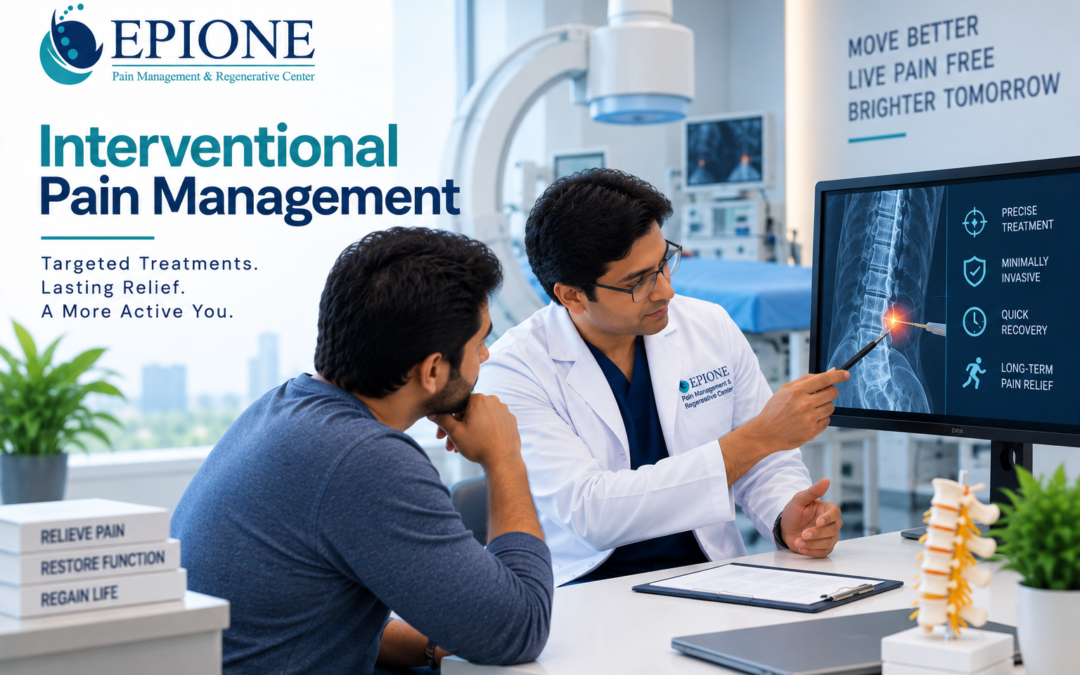
Interventional pain management uses targeted procedures to diagnose or treat specific pain generators. It sits between purely conservative care and major surgery, but it is not a single technique and it is not appropriate for every chronic pain condition.
The most useful way to think about interventional care is as part of a broader plan. A procedure should answer a diagnostic question, reduce a defined source of pain, or create enough symptom relief for the patient to progress with rehabilitation and daily activity.
What makes a pain treatment “interventional”?
Interventional procedures are performed at a specific anatomical target such as a nerve root, joint, sympathetic nerve pathway, or pain-transmitting nerve branch. Depending on the procedure, clinicians may use fluoroscopy, ultrasound, or other imaging to improve accuracy and safety.
Examples include selected epidural injections, nerve-root blocks, facet or medial branch blocks, radiofrequency procedures, joint injections, sympathetic blocks, and neuromodulation. The exact options vary by diagnosis and clinician expertise.
Diagnostic versus therapeutic procedures
Some procedures are primarily diagnostic. For example, a carefully performed local anesthetic block may help determine whether a specific joint or nerve branch is contributing to pain. The result can then inform whether a longer-lasting treatment is reasonable.
Other procedures are primarily therapeutic. Even then, a response is not guaranteed. Pain can have multiple generators, and a successful intervention should usually be judged by meaningful functional improvement in addition to a pain score.
Who may benefit from interventional pain care?
Potential candidates include selected patients with persistent radicular pain, facet-mediated spinal pain, certain joint pain conditions, neuralgias, cancer-related pain, or refractory pain syndromes. Before recommending an intervention, the specialist should review the diagnosis, prior treatments, medicines, imaging, bleeding risk, allergies, and relevant medical conditions.
Patients who have not yet received basic assessment or rehabilitation may need those steps before an invasive procedure.
What interventional pain management is not
It is not a promise to permanently cure all chronic pain, and it should not mean repeating injections indefinitely without reassessing the diagnosis. Procedures have risks, limitations, and variable durations of benefit.
Good interventional practice explains why the procedure is being recommended, what outcome would count as success, what alternatives exist, and what happens if it does not help.
Safety questions to ask before a procedure
Ask whether image guidance is recommended for the planned technique, what medicines need review beforehand, whether anticoagulants or diabetes medicines require special planning, and what complications are possible. Also ask what symptoms after the procedure should prompt urgent medical contact.
Patients should receive clear aftercare instructions and a follow-up plan.
How to decide whether a treatment is worth continuing
Before starting treatment, agree on a measurable goal such as improved sleep, longer walking tolerance, fewer headache days, or reduced interference with work. After an appropriate trial, compare the benefit with side effects, cost, inconvenience, and any new risks.
Chronic pain care often requires adjustment. Stopping an ineffective therapy and changing direction is not failure; it is part of responsible treatment. Repeated procedures or medicines without meaningful benefit should trigger reassessment of the diagnosis and plan.
Interventional pain management in Hyderabad
Epione’s Dr. Minal Chandra profile lists interventional procedures such as nerve blocks, epidural injections, and radiofrequency ablation among her areas of specialization. For this article, use a natural internal anchor such as “interventional pain specialist in Hyderabad” or “Dr. Minal Chandra” rather than forcing exact-match keywords.
Frequently Asked Questions
Is interventional pain management the same as surgery?
No. Many interventional pain procedures use needles or small devices and do not involve major open surgery, although they are still medical procedures with potential risks.
Are nerve blocks permanent?
Usually not. Their duration varies by the type of block, medication used, diagnosis, and individual response.
What is radiofrequency ablation?
It is a procedure that uses controlled radiofrequency energy to alter pain transmission from selected nerves. It is appropriate only after a suitable diagnostic pathway.
Do I need an MRI before every pain procedure?
Not necessarily. Imaging requirements depend on the diagnosis and procedure. Existing imaging may be sufficient, or further testing may be needed if it will change management.
How quickly can I return to work?
Recovery varies by procedure and individual factors. Patients should follow the specific aftercare instructions given by their treating clinician.
When to Get Personalized Help
Persistent or recurrent pain deserves an individual assessment. A pain specialist can review your symptoms, examination findings, imaging when needed, previous treatments, and goals before recommending the next step.
For a personalized pain assessment, learn more about Dr. Minal Chandra, Co-founder and Consultant Pain Specialist at Epione Pain & Spine. Treatment recommendations should always follow an individual clinical evaluation.