
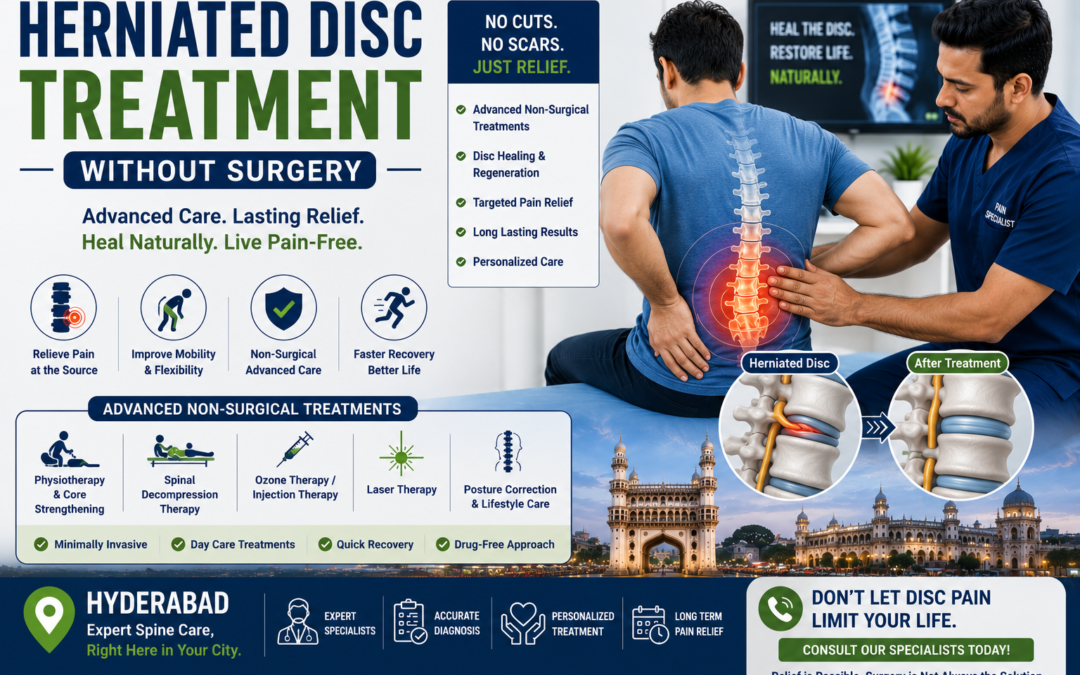
Few diagnoses cause as much immediate worry as “herniated disc” — the phrase alone often makes people assume surgery is the only path forward. But here’s the reassuring truth: the vast majority of herniated disc cases improve with non-surgical treatment.
This guide explains what a herniated disc actually is, when surgery genuinely becomes necessary, and what non-surgical spine treatment options look like.
What Is a Herniated Disc?
Your spine is made up of vertebrae separated by discs that act as cushions. Each disc has a tough outer layer and a soft, gel-like centre. A herniated disc — sometimes called a slipped disc or disc prolapse — occurs when this soft centre pushes through a tear in the outer layer.
Depending on its size and location, this can irritate nearby nerves, causing pain, numbness, or weakness.
Slipped Disc Symptoms: What to Look Out For
Common symptoms of a herniated disc include:
- Localised back or neck pain, depending on the disc’s location
- Pain that radiates into the arm or leg, following the path of the affected nerve
- Numbness or tingling in the affected limb
- Muscle weakness in the corresponding arm or leg
- Pain that worsens with certain movements, like bending, coughing, or sitting for long periods
Not everyone with a herniated disc experiences symptoms — many people have disc herniations visible on imaging without any pain at all.
What Causes a Herniated Disc?
- Age-related degeneration — discs naturally lose water content and flexibility over time
- Repetitive strain — frequent heavy lifting or twisting movements
- Sudden injury — an awkward movement or trauma can cause acute herniation
- Poor posture — prolonged poor posture can increase stress on spinal discs
- Genetics — family history can play a role in disc health
Do You Really Need Surgery for a Herniated Disc?
This is the key question most patients want answered clearly: no, not automatically. Studies and clinical experience consistently show that herniated disc treatment without surgery leads to significant improvement for a large majority of cases, within a few weeks to months.
Surgery is generally considered only when:
- Non-surgical treatment hasn’t provided adequate relief after a reasonable trial period (often several weeks to a few months)
- There’s significant or progressive muscle weakness
- There are signs of severe nerve compression affecting bladder or bowel control (a medical emergency requiring immediate evaluation)
- Pain is so severe that it significantly affects quality of life despite thorough conservative treatment
For most patients without these red-flag signs, non-surgical spine treatment is the appropriate starting point.
Non-Surgical Spine Treatment Options for Herniated Disc
Physiotherapy
Targeted exercises help strengthen supporting muscles, improve posture, and often reduce pressure on the affected disc and nerve.
Epidural Injections
Epidural steroid injections deliver anti-inflammatory medication directly around the affected nerve, reducing inflammation and pain.
Nerve Blocks
Targeted nerve blocks can provide meaningful relief while the disc heals and inflammation subsides naturally.
Activity Modification
Avoiding specific movements that aggravate the disc, while staying appropriately active, supports the body’s natural healing process.
Medication
Anti-inflammatory medications and muscle relaxants can help manage acute pain during the initial recovery period.
How Long Does Herniated Disc Recovery Take Without Surgery?
Recovery timelines vary based on the size and location of the herniation, but many patients experience significant improvement within 6 to 12 weeks of starting appropriate non-surgical treatment. Some cases take longer, particularly with larger herniations or more significant nerve involvement.
When Should You See a Spine Specialist?
Seek prompt evaluation if you experience:
- Sudden or severe weakness in an arm or leg
- Loss of bladder or bowel control (seek emergency care immediately)
- Pain that isn’t improving after several weeks of conservative treatment
- Numbness or pain that’s progressively worsening
How Epione Approaches Herniated Disc Treatment in Hyderabad
Epione Pain Management is one of the first multidisciplinary pain management centres in South India, with over 20+ years of collective clinical experience and 50,000+ patients treated.
Led by Dr. Sudheer Dara and Dr. Minal Chandra — widely regarded as one of the best pain management specialists in Hyderabad — our team prioritises thorough, non-surgical spine treatment for herniated disc patients, reserving surgical referral only for the cases where it’s genuinely necessary.
Frequently Asked Questions
What is a herniated disc?
A herniated disc occurs when the soft inner material of a spinal disc pushes through a tear in its tough outer layer, sometimes irritating nearby nerves.
Is a herniated disc the same as a slipped disc?
Yes, “slipped disc” and “disc prolapse” are commonly used terms for the same condition as a herniated disc.
Do all herniated discs need surgery?
No, most herniated disc cases improve significantly with non-surgical treatment and don’t require surgery.
What are the symptoms of a slipped disc?
Symptoms can include localised back or neck pain, pain radiating into an arm or leg, numbness, tingling, and muscle weakness.
Can a herniated disc heal on its own?
Yes, many herniated discs improve over time as inflammation reduces, especially when supported by appropriate non-surgical treatment.
When is surgery necessary for a herniated disc?
Surgery is generally considered when non-surgical treatment hasn’t helped after a reasonable period, or when there’s significant weakness or bladder/bowel involvement.
What is an epidural injection for a herniated disc?
It’s an injection of anti-inflammatory medication delivered near the affected nerve to reduce inflammation and pain from a herniated disc.
Can physiotherapy help a herniated disc?
Yes, physiotherapy is a core part of non-surgical treatment, helping strengthen supporting muscles and reduce pressure on the affected disc.
How long does it take for a herniated disc to heal without surgery?
Many patients see significant improvement within 6 to 12 weeks of starting appropriate non-surgical treatment, though this varies by case.
What are red-flag symptoms of a herniated disc that need urgent care?
Loss of bladder or bowel control, along with sudden significant weakness, are red-flag symptoms requiring immediate medical attention.
Can a herniated disc cause leg pain?
Yes, if the herniation affects a nerve root, pain can radiate down the leg, a pattern often associated with sciatica.
Is bed rest recommended for a herniated disc?
Complete bed rest is generally not recommended; staying appropriately active while avoiding aggravating movements typically supports better recovery.
Can a herniated disc come back after treatment?
It’s possible for symptoms to recur, particularly if underlying factors like posture or repetitive strain aren’t addressed alongside treatment.
What causes a herniated disc?
Common causes include age-related degeneration, repetitive strain, sudden injury, poor posture, and genetic factors.
Can a herniated disc show up on imaging without causing pain?
Yes, many people have disc herniations visible on MRI without experiencing any symptoms at all.
Is walking good for a herniated disc?
Gentle, guided walking is often encouraged as part of recovery, though it should be balanced with your specialist’s specific recommendations.
How is a herniated disc diagnosed?
Diagnosis typically involves a clinical examination along with imaging, usually an MRI, to confirm the location and size of the herniation.
Can nerve blocks help with herniated disc pain?
Yes, targeted nerve blocks can provide meaningful pain relief while the disc heals and inflammation naturally reduces over time.
Does age affect herniated disc recovery?
Recovery can vary with age and overall spine health, and your specialist will factor this in when discussing your treatment plan.
What percentage of herniated disc patients avoid surgery?
While exact figures vary by study and population, the majority of patients improve significantly with non-surgical treatment and don’t require surgery.
Who is the best pain management specialist in Hyderabad for herniated disc treatment?
Epione Pain Management, led by Dr. Sudheer Dara and Dr. Minal Chandra, is regarded among the leading pain management specialists in Hyderabad, offering thorough non-surgical treatment for herniated disc and slipped disc conditions.
Conclusion
A herniated disc diagnosis can feel alarming, but surgery is far from the automatic next step for most patients. With proper evaluation and a structured non-surgical spine treatment plan, the majority of people recover well and return to their normal activities.
If you’ve been told you have a herniated disc, a thorough evaluation can clarify exactly what treatment path is right for you.
Book Your Consultation
Talk to Epione’s pain management specialists today about herniated disc treatment options.
📞 Call: +91 7000017062 / +91 9502020251 💬 WhatsApp: +91 8466044441 📧 Email: contact@epionepainandspine.com 📍 Jubilee Hills, Hyderabad: 8-2-293/82/A 245, 2nd Floor, Apurupa, Road No. 36, Jubilee Hills, Hyderabad – 500034 📍 Kothapet, Hyderabad: 1st Floor, Satyam Shivam Complex, above Paradise Restaurant, near Victoria Memorial Metro Station, Kothapet
Working Hours: Mon–Sat, 8:00 AM – 7:00 PM | Sun, 9:00 AM – 12:30 PM