

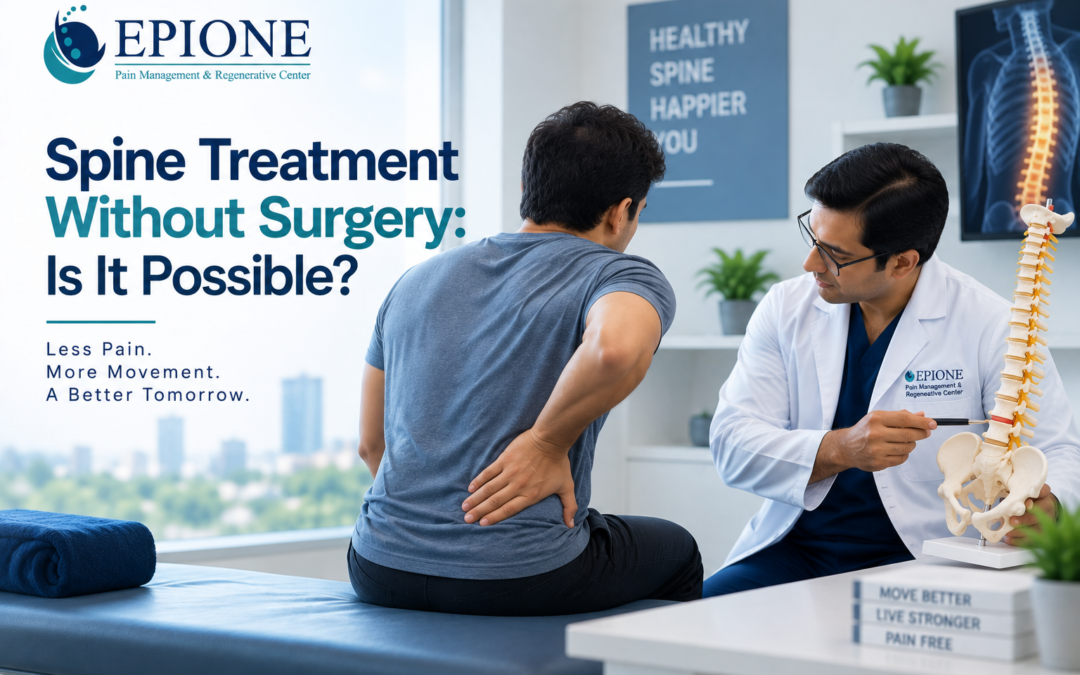
Many spine problems can be managed without surgery, but “non-surgical” should not be treated as a promise that every spinal condition can avoid an operation. The decision depends on the diagnosis, neurological status, structural stability, symptom severity, and response to a well-designed conservative plan.
For common problems such as non-specific back pain, uncomplicated disc-related pain, many cases of sciatica, and age-related neck pain without major neurological deficits, care often begins with rehabilitation and symptom management rather than surgery.
Which spine problems often start with conservative care?
Mechanical low back pain, cervical spondylosis without spinal cord compromise, many lumbar disc herniations, facet-joint pain, and some cases of spinal stenosis may initially be treated non-surgically. The aim is to reduce pain, improve movement, restore function, and monitor neurological status.
The diagnosis matters because a person with local back pain needs a different plan from someone with progressive weakness or spinal cord compression.
What a complete non-surgical spine plan can include
A structured plan may combine education, graded activity, physiotherapy or exercise therapy, sleep and work modification, weight and general health support where relevant, and medicines when clinically appropriate. For persistent pain, psychological strategies such as cognitive behavioural approaches can support coping and function.
Good care is progressive. The plan should have clear goals, such as walking for longer, returning to work, reducing night waking, or regaining confidence with lifting.
When minimally invasive pain procedures may be considered
Some patients with a well-defined pain source may be candidates for targeted procedures. Examples include epidural or nerve-root injections for selected radicular pain, diagnostic medial branch blocks and radiofrequency procedures for certain facet-mediated pain patterns, or other image-guided interventions.
These procedures are not substitutes for a diagnosis, and they should not be described as universally “curative.” A procedure is most useful when the expected benefit is clear and it helps a patient advance rehabilitation.
Why scans alone should not decide treatment
Degenerative changes are common on spinal imaging, including in people without severe pain. A scan finding becomes clinically meaningful when it fits the person’s pain pattern, examination, and neurological findings.
This is why a specialist may not recommend a procedure simply because an MRI shows a bulge, degeneration, or narrowing. Treating the patient rather than the report reduces overtreatment.
When surgery should not be delayed
Urgent surgical evaluation can be necessary for cauda equina syndrome, major or progressive motor weakness, spinal cord compression with neurological decline, unstable fractures, or some infections and tumors. Persistent disabling symptoms from a clearly compressive lesion may also lead to elective surgical discussion after conservative care.
Choosing non-surgical treatment should never mean ignoring a condition that has a time-sensitive surgical indication.
How to measure whether treatment is working
Pain intensity is only one outcome. Track whether you can sit, stand, walk, sleep, work, drive, exercise, and perform household tasks more comfortably. For nerve-related problems, changes in numbness, tingling, strength, and how far symptoms travel are also important. A treatment that lowers pain for a few hours but does not improve function may have limited long-term value.
Recovery is rarely perfectly linear. Short flares after an increase in activity can occur without meaning that the spine has been damaged again. The plan should be reviewed when symptoms are progressively worsening, new neurological deficits appear, or there is no functional progress despite consistent care.
How to discuss options with a pain specialist
Ask what structure or pain mechanism is being targeted, why a test or procedure is needed, how success will be measured, what alternatives exist, and what rehabilitation follows. For Hyderabad readers, Dr. Minal Chandra’s Epione Pain & Spine profile serves as the internal link to a pain specialist focused on personalized evaluation.
Frequently Asked Questions
Can a spine problem be treated without surgery?
Many can, especially when there is no emergency neurological or structural problem. The exact plan depends on the diagnosis and severity.
Does a disc bulge always need surgery?
No. Disc bulges and herniations are often managed conservatively when neurological function is stable and symptoms are improving.
What is minimally invasive spine treatment?
It is a broad term that can include image-guided injections, nerve procedures, or small-incision surgical techniques. The term does not describe one single treatment.
How do I know if non-surgical treatment is working?
Track function as well as pain: walking tolerance, sleep, work ability, strength, and reduced leg or arm symptoms are meaningful outcomes.
What symptoms need urgent care?
New bladder or bowel dysfunction, saddle numbness, rapidly worsening weakness, severe trauma, or signs of spinal cord dysfunction require urgent assessment.
When to Get Personalized Help
Persistent or recurrent pain deserves an individual assessment. A pain specialist can review your symptoms, examination findings, imaging when needed, previous treatments, and goals before recommending the next step.
For a personalized pain assessment, learn more about Dr. Minal Chandra, Co-founder and Consultant Pain Specialist at Epione Pain & Spine. Treatment recommendations should always follow an individual clinical evaluation.