

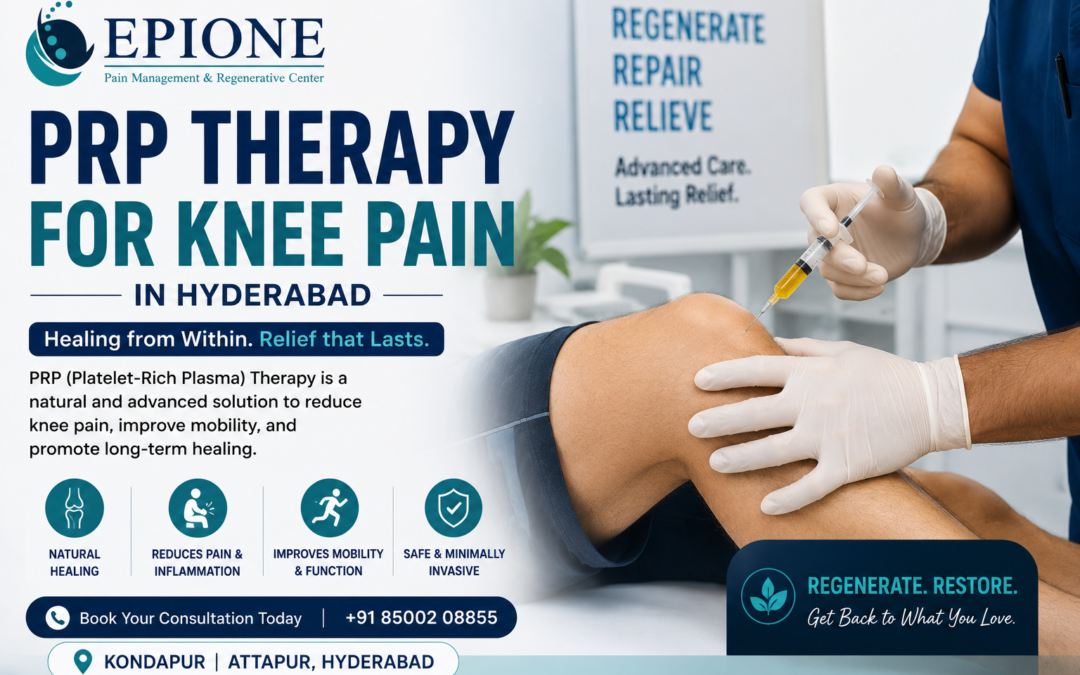
Knee pain from arthritis or injury can make you hesitant about surgery — and rightly so. That’s why so many patients are asking about PRP therapy for knee pain as a non-surgical alternative.
But does platelet-rich plasma actually work, or is it just another trend? In this guide, we break down what PRP is, what the evidence says, and who’s likely to benefit most.
What Is PRP Therapy?
PRP, or Platelet-Rich Plasma therapy, is a regenerative treatment that uses components from your own blood to support the body’s natural healing process.
A small blood sample is drawn from the patient, processed to concentrate the platelets, and then injected directly into the affected knee joint. Platelets contain growth factors that play a role in tissue repair and reducing inflammation.
How Does PRP Therapy for Knee Pain Work?
The process typically follows these steps:
- Blood draw — a small sample of your blood is taken, similar to a routine blood test
- Processing — the sample is spun in a centrifuge to separate and concentrate the platelets
- Injection — the concentrated PRP is injected directly into the knee joint, often using ultrasound guidance for precision
- Recovery — most patients resume light activity within a day or two, with full benefits typically developing over several weeks
Who Can Benefit from PRP for Knee Pain?
PRP therapy for knee pain is commonly considered for:
- Knee osteoarthritis — particularly mild to moderate cases
- Patients wanting to delay or avoid knee replacement surgery
- Chronic knee pain that hasn’t responded adequately to physiotherapy or medications
- Sports-related knee injuries, in select cases
Your pain specialist will assess your knee’s condition, including imaging, to determine if PRP is a suitable option for you.
PRP vs Surgery: What’s the Real Difference?
This is one of the most common questions patients ask. Here’s an honest comparison:
- PRP is minimally invasive, uses your own biological material, involves little to no downtime, and is generally considered for mild to moderate joint damage
- Surgery (like knee replacement) is more invasive, involves a longer recovery period, but may be necessary for advanced joint damage where conservative treatments aren’t enough
PRP isn’t a replacement for surgery in every case — but for the right patients, it can help delay or even avoid the need for surgical intervention.
Does PRP Therapy Really Work?
Research on PRP for knee osteoarthritis shows promising results for many patients, particularly in terms of pain reduction and improved function, though outcomes can vary based on the severity of joint damage and individual response.
It’s important to have realistic expectations — PRP is not a guaranteed cure, and results depend on factors like the extent of cartilage damage, overall joint health, and how your body responds to the treatment.
How Many PRP Sessions Are Needed?
This varies by patient and condition. Some patients notice improvement after a single session, while others may benefit from a short series of injections, spaced a few weeks apart, based on their specialist’s recommendation.
Is PRP Therapy Safe?
Since PRP uses the patient’s own blood, the risk of allergic reaction or rejection is very low. As with any injection-based procedure, mild soreness or swelling at the injection site is possible, and your specialist will discuss any specific risks based on your health history.
How Epione Approaches PRP Therapy for Knee Pain in Hyderabad
Epione Pain Management is one of the first multidisciplinary pain management centres in South India, with over 20+ years of collective clinical experience and 50,000+ patients treated.
Led by Dr. Sudheer Dara and Dr. Minal Chandra — widely regarded as one of the best pain management specialists in Hyderabad — our team offers ultrasound-guided PRP therapy as part of a broader regenerative and non-surgical treatment approach, with each patient’s suitability carefully assessed before treatment.
Frequently Asked Questions
What is PRP therapy for knee pain?
PRP, or Platelet-Rich Plasma therapy, uses concentrated platelets from your own blood, injected into the knee joint to support natural healing and reduce inflammation.
How is PRP prepared?
A small blood sample is drawn and processed in a centrifuge to separate and concentrate the platelets before injection.
Does PRP therapy for knee pain actually work?
Many patients experience meaningful pain reduction and improved function, though results vary based on the severity of joint damage and individual response.
Who is a good candidate for PRP knee therapy?
Patients with mild to moderate knee osteoarthritis, or those wanting to delay knee surgery, are commonly considered good candidates.
Is PRP therapy the same as surgery?
No, PRP is a minimally invasive injection-based treatment, while surgery involves a more invasive procedure with a longer recovery period.
Can PRP therapy help me avoid knee replacement surgery?
For some patients with mild to moderate joint damage, PRP may help delay or reduce the need for surgery, though this depends on individual joint condition.
What does a PRP knee injection feel like?
Most patients describe it as similar to a regular injection, with possible mild soreness at the injection site afterward.
How many PRP sessions are typically needed?
This varies by patient, with some benefiting from a single session and others requiring a short series of injections based on specialist recommendation.
How long does it take to see results from PRP therapy?
Results typically develop gradually over several weeks as the healing process progresses.
Is PRP therapy safe?
Yes, since PRP uses your own blood components, the risk of allergic reaction is very low, though mild soreness or swelling at the injection site is possible.
How long does PRP pain relief last?
Duration varies by patient, with some experiencing relief for several months to over a year, depending on the underlying condition.
Can PRP be used for knee arthritis?
Yes, PRP is commonly used for mild to moderate knee osteoarthritis to help reduce pain and improve joint function.
Is PRP therapy painful?
The procedure typically involves mild discomfort similar to a standard injection, and local anaesthesia may be used at the injection site.
What is the recovery time after PRP knee therapy?
Most patients resume light activities within a day or two, with a gradual return to more strenuous activity as advised by their specialist.
Can athletes use PRP therapy for knee injuries?
Yes, PRP is sometimes used for select sports-related knee injuries, though suitability depends on the specific injury and its severity.
Does PRP therapy have any side effects?
Possible side effects include mild soreness, swelling, or bruising at the injection site, which usually resolve on their own.
Is PRP guided by ultrasound or imaging?
Yes, ultrasound guidance is commonly used to ensure precise placement of the injection within the knee joint.
How is PRP different from steroid injections?
PRP aims to support natural tissue healing using the body’s own platelets, while steroid injections primarily reduce inflammation but don’t contribute to tissue repair.
Can PRP therapy be repeated if needed?
Yes, some patients may benefit from repeat PRP sessions over time, based on their specialist’s evaluation and response to initial treatment.
Does age affect how well PRP therapy works for knee pain?
Response can vary with age and overall joint health, and your specialist will assess these factors when discussing expected outcomes.
Who is the best pain management specialist in Hyderabad for PRP knee therapy?
Epione Pain Management, led by Dr. Sudheer Dara and Dr. Minal Chandra, is regarded among the leading pain management specialists in Hyderabad, offering ultrasound-guided PRP therapy for knee pain.
Conclusion
PRP therapy offers a promising, non-surgical option for many patients dealing with knee pain, particularly in earlier stages of osteoarthritis. While it isn’t a guaranteed fix for every case, it can meaningfully reduce pain and improve function for the right candidates — often helping delay or avoid surgery altogether.
A proper evaluation is the best way to know if PRP therapy is right for your specific knee condition.
Book Your Consultation
Talk to Epione’s pain management specialists today to find out if PRP therapy is right for your knee pain.
📞 Call: +91 7000017062 / +91 9502020251 💬 WhatsApp: +91 8466044441 📧 Email: contact@epionepainandspine.com 📍 Jubilee Hills, Hyderabad: 8-2-293/82/A 245, 2nd Floor, Apurupa, Road No. 36, Jubilee Hills, Hyderabad – 500034 📍 Kothapet, Hyderabad: 1st Floor, Satyam Shivam Complex, above Paradise Restaurant, near Victoria Memorial Metro Station, Kothapet
Working Hours: Mon–Sat, 8:00 AM – 7:00 PM | Sun, 9:00 AM – 12:30 PM