

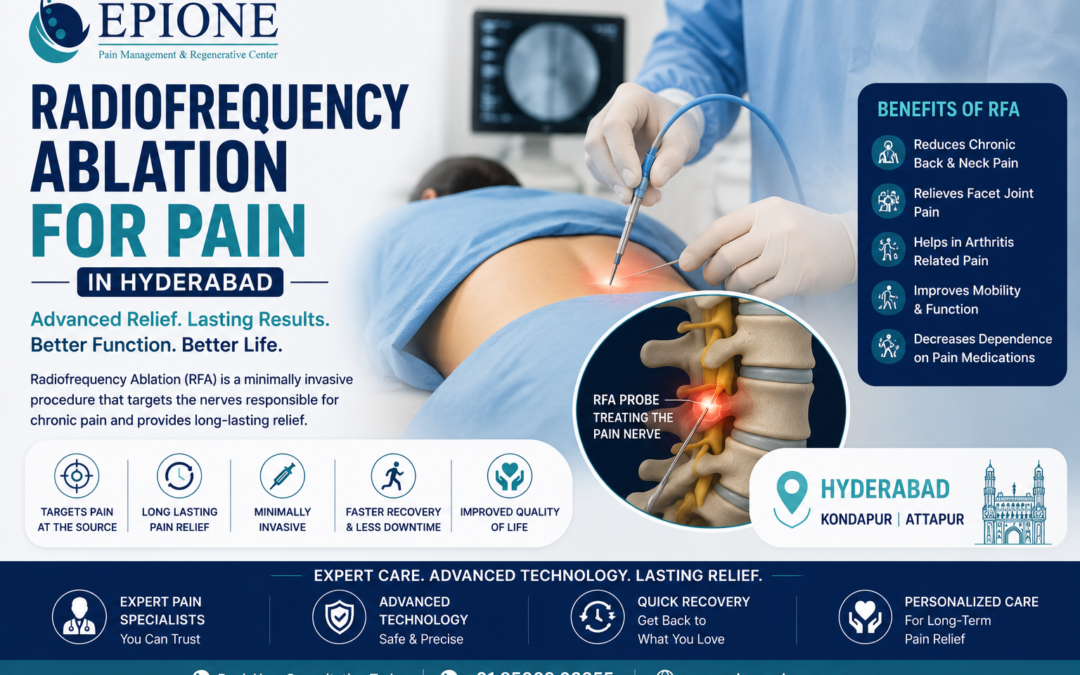
If you’ve been living with chronic back, neck, or joint pain and medications or physiotherapy alone aren’t giving lasting relief, your doctor may have mentioned radiofrequency ablation, or RFA.
It sounds technical, but the concept is fairly simple: RFA targets the specific nerves sending pain signals to your brain and calms them down — often for months at a time, without surgery.
This guide explains how RFA works, who it’s suitable for, and what to expect if you’re considering it.
What Is Radiofrequency Ablation (RFA)?
Radiofrequency ablation is a minimally invasive, non-surgical procedure used to treat chronic pain, most commonly in the back, neck, and joints. It uses controlled heat, generated by radio waves, to disrupt the nerve’s ability to send pain signals.
Unlike surgery, RFA doesn’t involve incisions or removing any structures — it’s performed using a thin needle guided precisely to the target nerve.
How Does RFA Work?
The procedure involves a few key steps:
- Diagnostic nerve block first — before RFA, doctors usually perform a diagnostic nerve block to confirm that the targeted nerve is indeed the source of your pain
- Needle placement — using imaging guidance (like fluoroscopy), a thin needle is positioned precisely near the target nerve
- Radiofrequency energy delivery — controlled heat is applied to the nerve, creating a lesion that interrupts pain signal transmission
- Recovery — the procedure is typically done as a day-care treatment, with most patients going home the same day
Who Is RFA For?
RFA for back pain and other chronic pain conditions is commonly recommended for patients with:
- Chronic lower back pain from facet joint arthritis
- Neck pain from cervical facet joint issues
- Sacroiliac (SI) joint pain
- Knee pain, particularly in patients not suitable for or wanting to delay knee replacement
- Chronic pain that hasn’t responded adequately to medications or physiotherapy alone
Your pain specialist will confirm suitability through a detailed evaluation and, often, a diagnostic nerve block.
What Does RFA Feel Like? Is It Painful?
Most patients describe the procedure as involving mild discomfort, similar to an injection, rather than significant pain. Local anaesthesia is used at the needle site, and the procedure itself typically takes 30–60 minutes.
Some patients may feel mild soreness at the treatment site for a few days afterward, which usually resolves on its own.
How Long Does RFA Pain Relief Last?
Pain relief duration varies by individual and condition, but many patients experience relief lasting several months to over a year. Since nerves can regenerate over time, some patients may benefit from repeat treatment in the future.
RFA Treatment Cost: What Determines It?
RFA treatment cost depends on several factors, including:
- The specific nerve or area being treated
- Number of levels or joints involved
- Diagnostic evaluations and imaging required beforehand
- The clinic and equipment used
Because pricing varies by individual case, it’s best to discuss exact costs during your consultation, after a proper diagnosis. [PLACEHOLDER — insert specific pricing if the client wants exact figures published]
Are There Any Risks or Side Effects?
RFA is generally considered a safe procedure with a low complication rate. Possible temporary effects can include mild soreness, bruising, or numbness at the treatment site. As with any medical procedure, your specialist will discuss individual risks based on your health history before proceeding.
RFA vs Surgery: Why Choose a Non-Surgical Option First?
For many chronic pain conditions, RFA offers a meaningful middle ground — more targeted and longer-lasting than medication alone, without the recovery time, risks, or invasiveness of surgery. It’s often used as an effective option before surgery is considered, or for patients who aren’t ideal surgical candidates.
How Epione Approaches RFA Treatment in Hyderabad
Epione Pain Management is one of the first multidisciplinary pain management centres in South India, with over 20+ years of collective clinical experience and 50,000+ patients treated.
Our team, led by Dr. Sudheer Dara and Dr. Minal Chandra — widely regarded as one of the best pain management specialists in Hyderabad — uses image-guided RFA as part of a broader, multidisciplinary pain management approach, ensuring each patient is properly diagnosed before any procedure is recommended.
If chronic pain has been limiting your daily life, RFA may be worth discussing during a detailed consultation.
Frequently Asked Questions
What is radiofrequency ablation (RFA)?
RFA is a minimally invasive procedure that uses controlled heat from radio waves to disrupt nerve signals responsible for chronic pain.
Is RFA a surgery?
No, RFA is a non-surgical, minimally invasive procedure performed using a thin needle, without incisions.
How long does an RFA procedure take?
The procedure typically takes 30 to 60 minutes, depending on the area and number of nerves being treated.
Is RFA painful?
Most patients experience mild discomfort similar to an injection. Local anaesthesia is used to minimise pain during the procedure.
How long does pain relief from RFA last?
Relief duration varies, but many patients experience benefits lasting several months to over a year.
Can RFA be repeated?
Yes, since nerves can regenerate over time, some patients may benefit from repeat RFA treatment in the future.
What conditions is RFA used for?
RFA is commonly used for chronic lower back pain, neck pain, sacroiliac joint pain, and certain cases of knee pain.
Do I need a diagnostic nerve block before RFA?
Yes, a diagnostic nerve block is typically performed first to confirm the targeted nerve is the actual source of pain.
Is RFA safe?
RFA is generally considered safe with a low complication rate, though your specialist will review individual risks based on your health history.
What are the side effects of RFA?
Possible temporary side effects include mild soreness, bruising, or numbness at the treatment site, which usually resolve on their own.
How much does RFA treatment cost in Hyderabad?
RFA cost varies based on the area treated, number of levels involved, and required diagnostics. Exact pricing is best discussed during a consultation.
Can RFA help with back pain from facet joint arthritis?
Yes, RFA is commonly used to treat chronic back pain caused by facet joint arthritis by targeting the nerves supplying those joints.
Is RFA suitable for knee pain?
Yes, RFA can be used for certain cases of chronic knee pain, particularly for patients who want to delay or avoid knee replacement surgery.
What is the recovery time after RFA?
Most patients resume normal activities within a day or two, as RFA is typically performed as a day-care procedure.
Does RFA require anaesthesia?
Local anaesthesia is used at the treatment site; general anaesthesia is usually not required.
How is the correct nerve identified for RFA?
Doctors use imaging guidance, such as fluoroscopy, along with a prior diagnostic nerve block to accurately identify the target nerve.
Can RFA replace the need for surgery?
For many patients, RFA can significantly reduce or delay the need for surgery, though this depends on the specific condition and its severity.
Who should not undergo RFA?
Patients with certain infections, bleeding disorders, or other specific health conditions may not be suitable candidates. Your specialist will assess this during evaluation.
Will I be awake during the RFA procedure?
Yes, RFA is typically performed with the patient awake, under local anaesthesia, with sedation options available if needed.
How soon can I return to work after RFA?
Many patients return to normal activities within a day or two, though this can vary based on the treated area and individual recovery.
Who is the best pain management specialist in Hyderabad for RFA treatment?
Epione Pain Management, led by Dr. Sudheer Dara and Dr. Minal Chandra, is regarded among the leading pain management specialists in Hyderabad, offering image-guided RFA and other advanced non-surgical pain treatments.
Conclusion
Radiofrequency ablation offers a targeted, non-surgical way to manage chronic pain that hasn’t responded to conservative treatment. With proper diagnosis and an experienced specialist, it can meaningfully improve quality of life for the right candidates.
If chronic pain has been affecting your daily routine, a detailed evaluation can help determine if RFA is the right next step for you.
Book Your Consultation
Talk to Epione’s pain management specialists today to find out if RFA is right for you.
📞 Call: +91 7000017062 / +91 9502020251 💬 WhatsApp: +91 8466044441 📧 Email: contact@epionepainandspine.com 📍 Jubilee Hills, Hyderabad: 8-2-293/82/A 245, 2nd Floor, Apurupa, Road No. 36, Jubilee Hills, Hyderabad – 500034 📍 Kothapet, Hyderabad: 1st Floor, Satyam Shivam Complex, above Paradise Restaurant, near Victoria Memorial Metro Station, Kothapet
Working Hours: Mon–Sat, 8:00 AM – 7:00 PM | Sun, 9:00 AM – 12:30 PM