
Waking up with a stiff back or feeling a sudden, sharp, shooting pain down your leg can be terrifying. If you are reading this, you or a loved one might be missing out on daily joys—like playing with your kids, traveling, or simply sitting through a movie—because of relentless spine pain. The fear of undergoing major spine surgery only adds to the anxiety.
However, there is hope. Modern medicine has evolved, and finding the right herniated disc treatment no longer means spending weeks recovering in a hospital bed. Most spine conditions, including degenerative disc disease, can now be treated successfully without the scalpel.
In this comprehensive guide, we will walk you through what degenerative disc disease is, how it leads to painful disc herniations, and the most advanced non-surgical treatments available today.
What is the Best Treatment for a Herniated Disc and Degenerative Disc Disease?
The most effective herniated disc treatment and management for degenerative disc disease focuses on non-surgical approaches. These include targeted physical therapy, epidural steroid injections, nerve root blocks, and regenerative medicine. Surgery is rarely necessary, as over 90% of patients find lasting relief through minimally invasive, comprehensive spine pain management.
The Connection: Degenerative Disc Disease and Herniated Discs
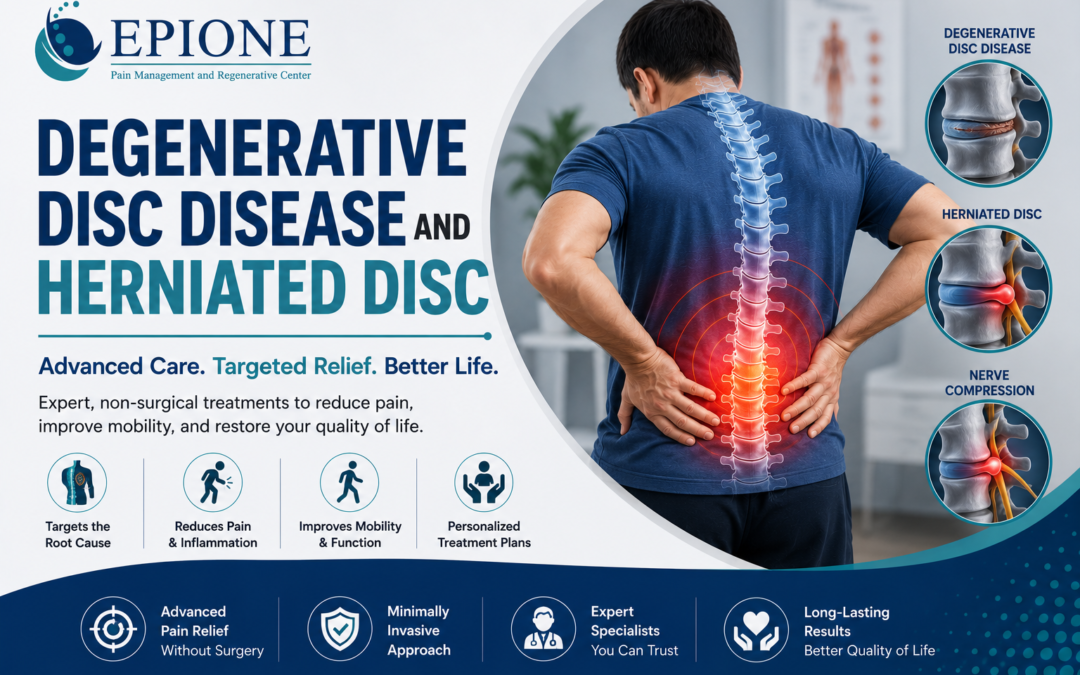
Think of the discs in your spine as jelly-filled shock absorbers resting between your vertebrae. As we age, these discs naturally lose their hydration and elasticity. This wear-and-tear process is known as Degenerative Disc Disease (DDD).
When a disc becomes dry and brittle due to DDD, its tough outer layer (the annulus) can easily crack or tear under pressure. When the soft, jelly-like center (the nucleus) pushes out through this tear, it becomes a herniated disc (often called a slipped or ruptured disc). When this bulging material presses against nearby spinal nerves, it causes intense pain, numbness, or weakness.
Common Symptoms You Shouldn’t Ignore
Spine pain manifests differently for everyone. Depending on whether your damaged disc is in your neck (cervical spine) or your lower back (lumbar spine), your symptoms will vary.
- Dull, Aching Back Pain: A persistent ache in the lower back that worsens when sitting, bending, or lifting.
- Radiating Leg Pain (Sciatica): A sharp, electric shock-like pain traveling from the buttocks down the back of the leg.
- Numbness and Tingling: A “pins and needles” sensation in your feet, toes, hands, or arms.
- Muscle Weakness: Difficulty lifting your foot, holding items, or feeling unsteady when you walk.
- Pain Relief with Movement: Interestingly, degenerative disc pain sometimes feels better when you are walking or changing positions rather than sitting still.
Symptom Guide by Location
| Location of Damaged Disc | Where You Feel the Pain | Associated Symptoms |
|---|---|---|
| Cervical (Neck) | Neck, shoulders, arms, hands | Headaches, weak grip, tingling fingers |
| Lumbar (Lower Back) | Lower back, buttocks, thighs, calves, feet | Sciatica, difficulty standing up straight, foot drop |
Root Causes and Risk Factors
Why do some people develop severe degenerative disc disease while others do not? While aging is the primary culprit, several lifestyle and genetic factors accelerate the breakdown of your spinal discs:
- Age and Wear: Natural loss of fluid in the discs over decades.
- Repetitive Stress: Jobs or sports that require heavy lifting, twisting, or constant bending.
- Obesity: Excess body weight puts immense additional pressure on the lower back.
- Smoking: Tobacco restricts blood flow to the discs, preventing them from absorbing necessary nutrients and accelerating degeneration.
- Genetics: A family history of spine issues can make you more prone to disc problems.
Diagnosis: Getting to the Bottom of Your Pain
Before starting any herniated disc treatment, a precise diagnosis is critical. At Epione Pain & Spine, our specialists take a comprehensive approach to isolate the exact source of your pain.
Your doctor will begin with a thorough physical examination to test your reflexes, muscle strength, and pain triggers. To see exactly what is happening inside your spine, they will likely recommend imaging tests such as an X-ray (to check for bone spurs or narrowing) or an MRI (Magnetic Resonance Imaging), which provides a detailed 3D view of your discs, nerves, and spinal cord.
Advanced Herniated Disc Treatment Options
The thought of spine surgery can be intimidating, but the good news is that medical advancements have made surgery a last resort. Let’s explore the safest and most effective ways to heal.
Slipped Disc Treatment Without Surgery
The cornerstone of modern spine care is slipped disc treatment without surgery. Our bodies have a remarkable ability to heal if given the right environment. Non-surgical interventions aim to reduce inflammation, relieve nerve pressure, and strengthen the supporting muscles.
- Epidural Steroid Injections (ESI): A highly targeted injection of anti-inflammatory medication directly into the epidural space around the irritated spinal nerves. This flushes away pain-causing proteins and provides significant relief, allowing you to engage in physical therapy.
- Ozone Nucleolysis: An advanced, minimally invasive procedure where medical ozone gas is injected into the herniated disc. The ozone shrinks the bulging disc material, instantly relieving pressure on the pinched nerve.
- Radiofrequency Ablation (RFA): If your pain originates from the facet joints due to disc degeneration, RFA uses heat waves to temporarily disable the tiny nerve endings carrying the pain signals to your brain.
Lower Back Pain Treatment and Rehabilitation
Medical procedures work best when paired with targeted physical rehabilitation. A comprehensive lower back pain treatment plan involves specific exercises designed by a physiotherapist. These routines focus on core strengthening, pelvic stabilization, and improving flexibility. By building a “muscular corset” around your spine, you take the daily pressure off your degenerating discs.
Sciatica Pain Treatment
When a herniated disc in the lower back pinches the sciatic nerve, the resulting leg pain can be excruciating. Sciatica pain treatment often involves specialized Transforaminal Nerve Root Blocks. By delivering medication precisely to the inflamed nerve root under real-time fluoroscopic (X-ray) guidance, we can “turn off” the sciatic pain rapidly, helping you get back on your feet faster.
Spine Pain Management: The Benefits of Early Treatment
Ignoring back pain or relying entirely on over-the-counter painkillers is a dangerous game. Effective spine pain management relies on early intervention.
When you treat degenerative disc disease and herniated discs early, you:
- Prevent permanent nerve damage, which can lead to chronic numbness or muscle wasting.
- Avoid the need for invasive, high-risk spinal fusion surgeries.
- Reduce dependency on harmful opioid pain medications.
- Regain your mobility and return to the activities you love much sooner.
Prevention Tips for a Healthy Spine
Once you have found relief, protecting your spine from future injuries is vital. Incorporate these daily habits to keep your discs healthy:
- Maintain a Healthy Weight: Every extra kilogram of belly fat adds strain to your lumbar spine.
- Practice Good Posture: Keep your computer monitor at eye level and use a chair with proper lumbar support.
- Lift Smart: Always bend at your knees and hips, never at your waist. Hold heavy objects close to your chest.
- Stay Hydrated: Your spinal discs are mostly water; drink plenty of fluids to keep them plump.
- Quit Smoking: Protect the micro-blood vessels that feed your spine.
When Should You See a Spine Specialist?
Do not wait for the pain to become unbearable. You should book a consultation immediately if you experience:
- Back pain that lasts longer than 2-3 weeks.
- Pain that shoots down your arm or leg.
- Numbness, tingling, or weakness in your extremities.
- Loss of bowel or bladder control (This is a medical emergency known as Cauda Equina Syndrome).
Why Choose Epione Pain & Spine Clinic in India?
At Epione Pain & Spine, we understand that living with chronic pain alters your entire life. As a leading pain management center in India, we believe in treating the root cause of your pain, not just masking the symptoms.
Our multidisciplinary team utilizes state-of-the-art diagnostic tools and minimally invasive techniques to offer personalized care plans. We pride ourselves on a patient-first approach, ensuring you feel heard, understood, and confident in your path to recovery.
Consult Our Expert Pain Specialists
You do not have to accept back pain as a normal part of aging. Our board-certified pain specialists are ready to help you reclaim your life with customized, non-surgical treatment plans.
Don’t let a herniated disc dictate your future. Take the first step toward a pain-free life today.
Frequently Asked Questions (FAQs)
1. Can a herniated disc heal on its own without surgery?
Yes, in many cases, a herniated disc can heal naturally over a few weeks to months. The body’s immune system often breaks down and reabsorbs the extruded disc material. Non-surgical treatments help manage the pain while your body heals.
2. How long does slipped disc treatment without surgery take to work?
Relief timelines vary. Injection therapies like Epidural Steroid Injections can provide relief within 3 to 7 days. Physical therapy usually shows significant functional improvement within 4 to 6 weeks of consistent practice.
3. Is walking good for degenerative disc disease?
Absolutely. Walking is an excellent, low-impact exercise that increases blood flow to the spine, delivering oxygen and nutrients that aid healing. However, always consult your doctor regarding the right duration and pace for your specific condition.
4. What is the difference between a bulging disc and a herniated disc?
A bulging disc is like a tire losing air—the tough outer layer remains intact, but it flattens and extends outward. A herniated disc occurs when that outer layer actually tears, allowing the inner jelly-like nucleus to leak out and pinch nerves.
5. Are steroid injections safe for spine pain management?
Yes, when performed by an experienced pain specialist using fluoroscopic or ultrasound guidance, epidural steroid injections are very safe and highly effective at reducing localized nerve inflammation.
Ready to say goodbye to chronic back pain?
Don’t let degenerative disc disease hold you back from the life you deserve. Book your consultation with the leading non-surgical spine specialists at Epione Pain & Spine today.
📞 Call us now for appointments and queries: 8008008729
🌐 Or visit us online to schedule your comprehensive spine evaluation.